

Introducing Our New President
Introducing Our New President
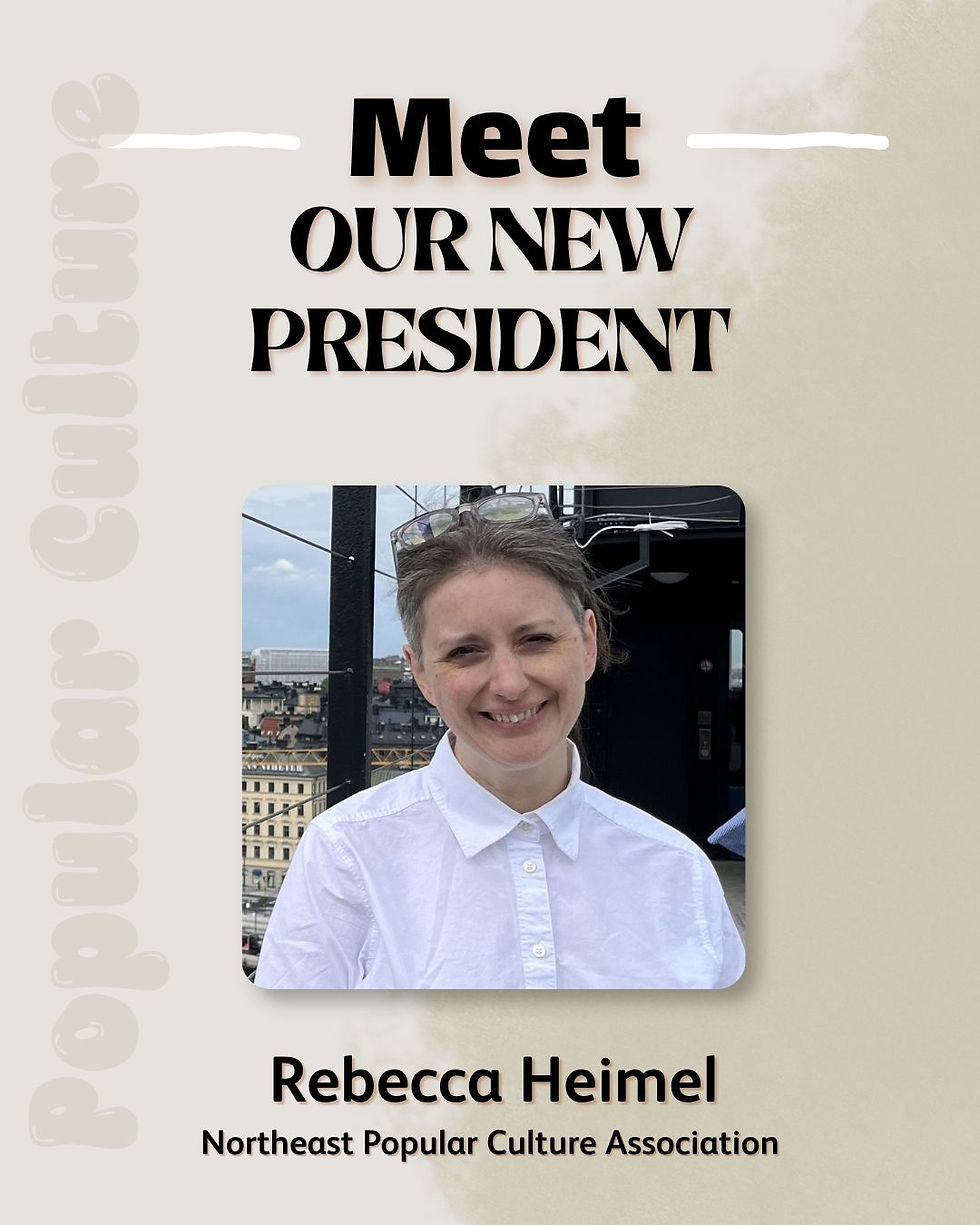
Rebecca Heimel
Rebecca taught for a decade at Cambridge College in Boston, ending her time there as the Elizabeth J. McCormack Chair of Humanities. She is currently the Dean of Teaching and Learning at MassBay Community College. Rebecca holds a PhD in Cultural Studies and is an active scholar in the field.
What first brought you to NEPCA?
Honestly, an economic treatise. Just kidding, kind of. In Exit, Voice, and Loyalty (1970), Albert Hirschman described two possible ways of responding when something disappoints you – Exit or Voice (note that I am not an economist, so I am over-simplifying this). I loved the American musical, and I knew it was a fraught form. I wanted to explore what scholarship looks like when my Loyalty to the form – by that I mean what makes me choose Voice over Exit – pushes me to regard the musical as valuable and worthy of attention, and my Voice wants to uncover the gender conventions, racial politics, and sanitized nostalgia of the musical. People tend to think of popular forms first as low-stakes; they seem to matter very little at face value. But actually, reckoning with musical theatre means reckoning with memory, representation, and cultural expression. I was drawn to NEPCA because we all agree here those stakes are actually quite high.
What does the future of NEPCA look like to you?
I imagine a future for NEPCA in which our members are engaged in, and in some way even defined by, the work we share with one another. And, I imagine we keep striving to be an organization that is unapologetically accessible in every sense of the word.
What was the favorite paper you gave at NEPCA?
In 2021 I gave a paper called “Chippewa, Iroquois, Omaha: Reconsidering Annie Get Your Gun” in which I got to dive deeply into the history of American Indian performers in Wild West shows. I still plan to go back to it some day and develop it further.
What is your current research obsession?
Outside of NEPCA and our Performance Studies area, I primarily focus on visual culture. I research public art in transit infrastructure (specifically urban transit systems), but lately I cannot stop obsessing about images of dam building produced by the U.S. Bureau of Reclamation in the 1930s and 40s. Let’s hope I’m going somewhere with this.

Comments